Showing posts with label Pagans and culture. Show all posts

Thursday, July 2, 2020

Starwood 39.5


Your Festival Staycation.

So, here in Ohio we continue to face Covid-related caution advisories. None of them have been Draconian – we’ve gone out for supplies as needed, but socializing here at Tredara has been minimal, and all spring/early summer events have been cancelled. As a result we have been learning how to use the internet for our work – our Druid Grove has offered our rites on live feeds, and we’re all meeting on various meeting-platforms.

As most of you know I’m a founder of and organizer for the Starwood festival, which is approaching its 40th opening this year. Things being what they are, this year we felt it wise to cancel our Big Camp-out. Instead we are producing a virtual event that we hope will be as interesting and engaging as a live Starwood.

Attendees will receive a link to the “Lobby”, where scheduled programs can be accessed. Beginning with the Opening Circle meditation on Tuesday evening, we will offer four days of workshop program. Each day will open with a “coffee at Camp” chat-meeting, where folks can get face-time, test their connection, ask questions, etc. We will often offer two, three or more choices per scheduled slot. 

I invite you to review the schedule and speaker list at the link. Selena Fox, Jeff McBride, Vermin Supreme, and so many of our favorite folks (we couldn’t possibly have them all…). Workshops will be interacting, tough our monitors will work to keep things organized, prevent extraneous noise, etc.
Musical guests will play at lunch-time and post-dinner slots each day, and various unusual overnight feeds will be accessed. We will maintain a non-themed chat-room, and offer unique programs from our 40-year archives.
There’s some fire-tribe building a Pretty Big Fire in my back meadow as we speak. Saturday night, after concert, we will light it and join our eyes and hearts together, even if we can’t all dance in the same place.

So if you have the cabin-fever, a persistent nagging itch to do something cool, and an ache in your bones for the fam, consider pitching in the measly fee.
Then get yer wi-fi in order, with a good screen, arrange some camp chairs (or your fave chairs…) around a fire – even a little bitty one, maybe get a cooler full of your fave cold stuff.  You can meet friends and like-minded mutants from across the planet (probably), while relaxing with your very own plumbing.
You can register at this page:
https://www.eventbrite.com/e/virtual-starwood-395-tickets-105711453804
It’s the 2020 thing to do…


Monday, September 30, 2019

13 Books To Introduce Modern Paganism

Out on the Internet there is a constant clamor by new students for direction, advice, and first-steps maps of the route into Pagan spirituality. It remains simply true that reading books is the primary door to Pagan ways. The ever-flowing streams of modern Pagan books can  be, in turn, puzzling for new students.

So I'll do another archival article, setting down my recommendations for a basic reading list. This list is focused on general-purpose Paganism, neither Wicca as such, nor any specific ethnic or reconstructionist path. I've tried to keep it practical - most of the titles give ideas and instruction on actually doing Paganism home and life. The list isn't about magic and occultism, though several of the listed titles give good instruction. Rather it concerns Paganism as spiritual and religious practice in personal life.

I might suggest reading one title from each category for a start, then working through the rest.


A: Survey and Background Two books that introduce general concepts and outline major traditions and styles of Paganism
1: The Path of Paganism; John Beckett: Beckett is a UU member and  Druid. His book introduces basic concepts of Pagan ways such as Sacred Space, Gods and Spirits, and the Seasonal Calendar. Very cross-traditional, well-thought-out and readable.
2: Pagan Paths; Pete Jennings: A survey of multiple named or nameable Pagan systems, paths and traditions, including witchcraft and Wicca, Northern Mysteries, Womyn’s Religion, etc.

B: Non-Wiccan Basic Paganism Three books that teach broad basic themes and practical approaches.
3: Basics of Ritual Worship; Ian Corrigan: A simple method of establishing home altars and shrines, beginning work with the spirits of nature and the gods, and establishing one’s Paganism in one’s life.
4: To Walk A Pagan Path; Alaric Albertson: Covers much of the same material – home temple, family ritual etc. Albertson is a Saxon Pagan, and the book has that slant, but is widely applicable.
5: A Book of Pagan Prayer; Ceisiwr Serith: A huge compilation of original prayers and invocations for Pagan worship. Most of the Prayers could be used in almost any traditional context.

C: Traditional Wicca: Wicca (Neopagan Witchcraft)  as developed in the mid-20th century was private, small-group-centered, and based on initiation and focused training.
6: Traditional Wicca: A Seeker’s Guide; Thorn Mooney: a discussion of what traditional Wicca is, and how to find your way to a traditional, initiating coven.
7: Buckland’s Complete Book of Witchcraft; Raymond Buckland: An at-home how-to for those who would like to practice Wicca in a traditional style, but haven’t found initiation.

D: Eclectic Wicca and Paganism: In the 1980s, Pagan festivals and public groups developed an eclectic style of Pagan ritual based loosely on traditional Wicca. Many modern ‘Wiccans’ work in this style.
8: Wicca, A Guide for the Solitary Practitioner; Scott Cunningham: Simple instructions, few rules, little connection to tradition, but very accessible, very doable. A book that changed the movement.
9: A Book of Pagan Rituals; Pagan Way (credited to Herman Slater, falsely): A full round of lunar and seasonal ceremonies designed for solo or small-group practice. This text has created countless small Pagan groups.

E: Non-Wiccan Witchcraft: ‘Witchcraft’ is a broad and indistinct category, and Wicca is far from the only style of it. I’ll include one good book, which will be made easier to understand by the other reading here.
10: Treading the Mill; Nigel Pearson;  a grimoire of English traditional Craft-style work. With rituals clearly related to those of Wicca, it brings a greater attention to the field and forest, to landspirits and ancestors.

F: Traditional Euro-Paganisms: Many Pagans find inspiration in a specific culture, such as Irish/Celtic, Hellenic or Norse.
11: Sacred Fire, Holy Well; Ian Corrigan: A review of Irish Gods and myths, with a full, non-wiccan style of ritual, Seasonal rites and works of magic and vision.
12: Hellenismos; Tony Mierzwicki:  Introduction to the Paganism of ancient Greece, home worship, invocation of the gods.
13: A Practical Heathen’s Guide to Asatru: Patricia Lafayllve: Norse Paganism is one of the most popular traditional paganisms today, and this presents a simple introduction.

Friday, May 31, 2019

A Declaration of Pagan Religious Rights and Duties


This is a draft of a statement of progressive socio-policy principles based on my understanding of basic Pagan religious choices and spiritual inclinations. While I have expressed it in the plural, it is my own reasoning and rhetoric, and no others’ – most notably it does not represent the opinion of ADF or any other group or whatsis with which I am associated. It is me at the end of a plank, neck stuck-out, right next to John Beckett this week.  
I invite critique. I have not attempted to fine-tune for obvious exceptions to these guidelines, which are many. I do not believe that setting simple rules and sticking to them without exception is generally wise, and so all this is offered only as an example of the kind of theological and values-thinking of which our movement is yet rather short.


I: Principles
1: Axiomata
• We declare that individual humans contain a worthy spark of the divine flame, a pure spring of the divine waters, and that the individual mind and will embody the divine will in those sparks and springs.
• We perceive that individuals are naturally entangled in the web of both nature and society (human nature). Therefore just as we owe honor to our own divine nature we owe conscious participation to our networks and the duty to ensure to individuals full and equal participation in all aspects of civic and religious life.
• We assert especially a holy sovereignty of the body, mind and will of living humans. Barring an unarguable need, it is not the business of community or individuals  to intrude on the choices of the flesh or spirit.
• We assert the divine freedom-of-action of every being as a primary Good. When such freedom is reduced the good of all is reduced, so let us be wary of responding to fear with restriction.

• Likewise we observe the interdependence of living things and systems, and acknowledge that individual will must often conform to larger need. In this we pray to wisdom for guidance.
• Because wellness and good outcomes are cumulative in a system we therefore undertake to seek wellness, wholeness and harmony in our lives and work.
• Thus we describe these principles, that we may seek that harmony for ourselves and our communities.

2: Property
• We perceive that the world and its beings belong each to ourselves. All being is holy life, and all life proceeds on its path as our interactions allow.
• It seems fair that individuals should claim such resources as are needed for their own life and work. When such claims are done in the public eye and with community consent we call such claiming ‘property’ and ‘ownership’.

• We assert the spiritual right to claim a hearth on the land, and take our spiritual place among the beings of the land. In this we follow the customs of our community, but we stand, at last, on our spiritual right of claiming.
• Such claiming bestows an equal responsibility for the well-being of the beings and communities of the land, balanced with our right to use resources according to our need. In this let us seek wisdom and balance.
• Therefor we also advise against greed. To hoard resources in private is to deprive community of its life-flow, for little beyond imagined benefit. Let wisdom teach the difference between prosperity and greed.

3: Gender, Love, and Pair-Bonding
• Perceiving gender-presentation to be a social construct, we affirm every individual’s holy right to be who they are led to be, according to their will and work.
• We assert that sexual and intimacy expression and the pursuit of sexual and intimate pleasure are of equal value to the bearing of children; that they develop and deepen the human person in ways otherwise unobtainable. We assert a religious right to seek sexual and intimate pleasure for our own sake, and that of the greater good of our communities.
• Therefore we acknowledge and celebrate the joining in Love of all people who are drawn together by true and holy Eros, or by Caritas, or even by Agape.
• Specifically we feel bound by religious duty to honor all bonds of loving union made between consenting persons. In this we again may take advice from the community, but we assert our religious right to sanction unions regardless of statute.

4: Duty to the Land
• We perceive the ‘ecosystem’ of the world around us as a direct expression of holy spiritual persons and powers, present in and as the land. A major part of our spiritual work is to establish and maintain relationship with those beings and systems.
• We choose to live as participants in the ecosystem in which we reside, doing our best to do good for both ourselves and for whole systems.
• Therefore we assert that human society has a collective duty to protect and maintain local and planetary ecosystems. We see a religious duty to pursue this work in our own lives, and in public policy, as we are able.

5: Duty to our Fellow-Humans
• We assert the individual sovereignty, as equally-noble spirits, of every mortal born. While fate and strength may set us all in our several places, we find no spiritual cause to see greater merit in one human ethnic clan, lineage, gender-group, or circumstance than in another. Individuals rise and fall according to our fates, and our heritage or biology need not be our destiny.
• We assert that it is contrary to harmony and beauty to grant privilege to one sort of human, or place restriction on another, based on the fate of their birth.

• Especially we hold that the gods and spirits are unconcerned with the family, ethnic, or gender heritage of their worshipers. Those who assert such things deform the truth.
• Therefore we welcome to the Hearth of Kinship and the Fire of Worship all who come with a guest’s heart, regardless of ethnic or gender presentation. We affirm a core of relationship with all humans.

6: Duty to the Gods and Spirits
• We perceive the divine in and as the uncountable beings of myth and lore, from the Ancient First Ones to the nearest garden-spirit. These beings great and small entwine in the webs of spiritual ecosystems.
• As ‘religion’ it is our work to help establish and maintain the relationships between mortals and the spirits. Therefore it is our religious duty and right to perform ceremonies of worship and spiritual craft, as our traditions teach.
• In this we claim all the customs and ways of those traditional religions; the raising of idols as presences of the divine; the establishment of Altars and Fires of Offering and worship; the honoring of the features and wonders of nature as the presence of the divine; the keeping of the Sacred Calendar, and the words and songs and deeds of ritual. Likewise we claim as part of holy tradition the practices of divination – sortilege, mediumship, and the seeking of omens; also the work of spiritual healing, and of spiritual methods of seeking luck, prosperity and blessing, which are often called ‘magic’.

II: Specifics

In light of these principles we claim these social and spiritual rights and duties of our religion, without disallowing any others which might reasonably follow from our premises:
• We assert the right to keep public and private rites of worship and offering without hindrance, and with the accommodation offered any religious body. This includes all the common works of religion – marriage, funeral, sacrament, and other personal-passages.
• We assert the right to make private spiritual services of the kind called divination and magic available to our folk and the community.

• We declare that every member of our society is kin, worthy of maintenance and the chance to contribute to the people’s good. We support societal effort to prevent and relieve disadvantage, hunger and want.
• We see that we, individually and collectively, owe the land the honor due a parent – to care for it as we would an aging Elder. We support careful restriction of commerce in service to those goals.
• We affirm the social equality of ‘queer’ sexual natures and gender non-conformity with the common norms. We affirm the value of personal sexual expression as greater than that of social conformity or regulation.

• We affirm reproductive autonomy and body sovereignty for all people. We support responsible reproductive planning for all people, and ready access to birth and pregnancy management for women and their doctors.
• We affirm the right to compose families and affection-groups as life and choice lead.

• Centrally we affirm both the sovereignty of individuals and the obligation of individuals toward the human collectives that sustain us, and likewise to the spiritual collectives existing in the worlds around us. Let us each keep our own flame, and come to the Fire of Sacrifice together.

Sunday, March 17, 2019

Tredara Good News


Spring 2019
Oh my friends, I have a story for you. It’s a good story, because it has a good ending, and being near the end of it makes me Very Happy.
Many of you know that I and my partner have, for many years, been using and developing our patch of land as Pagan sacred space. Starting with an 8-acre lot that Sue has been on since 1975, and expanding in 2013 to include 8 additional acres to our north. Along with a small patch on the other side we now work with 17ish acres. The tale begins following the expansion.

The new acreage was, when we purchased it, a disused satellite growing-field for the nursery-stock, shrubs, etc that is a common local agriculture. On our early inspections it was serene, with shoulder-high grass, overgrown shrubs and a variety of lovely flowering trees. It was a lovely acquisition, but with it we also acquired new neighbors. 
Just north of the northern boundary of this new property a family keeps their several acres of small agriculture, horses, etc. We seem to have frightened them. It was certainly the case that for as long as they had owned the property that patch had been quiet, even deserted… flowers, deer and bunnies, nice place for the dogs to run – I get that. Then comes us. The grass is mowed, the roads regraveled, regular tractor action, and people – our people. (for details on the progress, click the Tredara tab on the blog front-page, and recall that articles are reverse-time-line order)


Having acquired the acres in 2013, we immediately began building a new, larger worship space, and by the following spring we were holding our Stone Creed Grove seasonal rites in it during the summer. That fall we built a new 30 x 50’ pavilion-roof and attached shower-house. With that in place we hosted the ADF Wellspring Gathering at Tredara in May of 2016. This modest, 120-ish-person event had previously been held at the Brushwood folklore center, but this moved it into our full management.

Even prior to that we had our first visit from our local zoning inspector, who mentioned some neighbor concern and wondered just how commercial an operation we were running. He explained that some complaints about our activity (and some presumptuous youtube vid claims by me...) had brought him out, but was satisfied that we were making incidental use of our personal back-yard to host our church events.

The fact is that Tredara is not and has never been a ‘campground’. We do not charge by the night to camp, nor advertise ourselves in that way. We are, and have always been a sacred space for Pagan worship and spiritual practice. From the days in the 80s when our coven met in the woods, through the evolution of our public Druidic work the place is the private project of Lia Fal and I. We build in service to the Gods and the folk, and with honor to the land. While we have been blessed with donations we seldom seek them, and we’re just not in it for the money, as they say. Nevertheless, the place has been a buzz of construction, campers, hippies, pagan drumming and chanting and the installation of idols in the five-ish years we’ve owned it. I can understand a degree of culture-shock for the closest neighbors.

So this past fall the zoning inspector returned to our door, and had a look around. I’ll keep the details simple – our ‘agricultural’ zoning forgives a lot, but we’re not really doing agriculture. The decision was that our uses were ‘permitted’ under ‘conditional uses’ in the local ordinance. That began a process of determining the ‘conditions’ under which we would be permitted to continue.

Of course I was prepared to stand on the first amendment. I was allowing my church to use my farm for services and our annual reunion-campout. However in the USA if anything overrides the bill-of-rights it’s local land-use sovereignty. I hoped to avoid the employment of attorneys in the matter, and in the end I was able to do so. 

I have also had my faith in the culture of my corner of NE Ohio affirmed by the lack of passionate Christian opposition to our efforts. The offended neighbors held back from any religious reference, and we debated noise and imposition. Early on there *were* people at the podium with concerns about “what kind of church” was being permitted, but the members of the Board of Zoning Appels plainly said that such a topic was not at issue in the discussion. At no time past the very first speakers were our ways mocked or belittled – mainly they were accommodated. In the end there was no outcry from either Evangelical or Catholic local churches, may they be blessed by the spirits of America.

The offended neighbors leaned on issues of noise and property-security. It seems they had had a distressing random visit or two, which they wanted to attribute to our guests. We agree that good fences make good neighbors.

My kin, this all-winter process has had my brain just Parked! Our goal here has been to make a sacred space for the sake of our folk, and now we faced an external authority’s mandate on whether we would have to undertake a serious fight to keep our dream alive. Discussion happened only on the record at live meetings, so we were simply suspended for weeks at a time. By the final meeting quite a groove had been worn in my patience.

However the process was, I must judge, fair and right. The bureaucrats were helpful, the board members cooperative and neutral-to-neighborly. They all toured the place for an eyes-on judgement, and listened in fact to our needs and plans. It seems plain that they had never seen anything quite like us, before.

In the end we were granted our conditional use permit as a ‘place of public assembly’! The only bad news is a mandate to install a big, damned-expensive fence along the boundary with the offended neighbors. We’ll do it, fulfill a few other simple requirements, and be free to flow as a working Pagan sacred forest and worship garden here in NE Ohio.

Magic? Well, some… we’re not done with every little thing, but I’ll say that I began asking Certain Others for their aid last fall, and various measures have been taken over the months. I give thanks, of course, to all those who have aided us.
All in all this is the public birth of the Tredara Hearth Farm & Shrine. Now we can actually put up a sign (must do, in fact…) and publicly be what we have been. At this time we’re not soliciting new events, or looking to expand our event program. Rather we’ll focus on our facilities for worship, and making our occasional camping guests even more comfortable. Our sacred work will continue, teaching and incidental ceremony will probably increase, and we can begin really fitting ourselves into this thing we’ve built, and growing into the corners.


Sunday, June 3, 2018

A Pagan Pub-sing Folk-roots Discography


If you hang around me for any length of time, you discover that I'm a singer. I mean, I do perform on stage, with L. in a formal way. I'm also likely to burst into song at random nearly any time... sometimes whatever earworm or free-association has appeared in my head, sometimes just nonsense-lyrics to my cats. Nature gave me an acceptable voice, and I've worked it all my life, so I enjoy using it.

A.D.F. (Ár nDraíocht Féin) the Druid order I work in, is rather full of folks like me, in that regard. As a group focused on the pre-Christian religions of Europe, very little is more authentic to the spirit of the Old Ways than the singing of traditional songs. ADF rites are intended to be tuneful, with songs for walking and standing, for worship and for receiving blessings. It helps move us from the atmosphere of a ceremonial temple to that of a joyous village even as we do tight, detailed ritual.
After a cup of mead (or whatev) there is likely to be singing at our campfires. At least here in my region many of us share a certain repertoire, derived from the British and Celtic folk revival of the 70s and onward. We have grown up, musically on some of the same albums and performers, and these songs tend to burst from us at the slightest poke. 

The body of song and music that grows from the culture of the British Isles - England, Scotland and Ireland, to be simple - enjoyed a revival in the 1970s as a style of 'folk-rock'.  The bands and singers below mixed-and-matched, producing albums in multiple styles, varying between unadorned preservation and hot, 1970s psychedelic guitar. They drew their material from the deep wells of traditional music.

Whether Britain, Ireland or Scotland there is a store of folkloric music that has been preserved by scholars and periodically revived by performers. Much of this material is modern, from the age of sailing ships or steam engines - one can find many songs about the dire arrival of the factories. Some is historical, preserving causes and wars long passed. Shape-note church hymns, labor songs, and both celebrations and laments of common living are strung throughout. However many modern Pagans feel that bits and scraps of the kind of old lore we seek are preserved in these songs, sometimes in unlikely places. Shreds of lost English dialects, Gaelicisms in the Irish songs, and the long memory of the farmers and land-bound 'peasantry'. (... forgive me, much of this material is plainly peasant music, though there is a courtly tip) Songs of the seasonal year, planting and harvest, and narratives of spirit contact feel like they hold clues for us.


The albums linked below are core collections that I still recommend both for Pagan material, but also for general pub-singing, bardic circle performances and self-satisfaction on forest walks. It isn't Pagan music, primarily, but it is music that has inspired Pagan bards, and is being preserved folk-style in the mouths of many living singers in homes and at campfires. There's an emphasis on a capella singing and simple performances, though listen for the 70s hi-tech variants of some songs.

For your edicifation, I'll start here. This is Steeleye Span (more below), in recent years, still working. They are the paradigmatic brit folk-rock band, Featuring three or four of the artists I'll detail below, and the incomparable Maddie Prior on vocals. Yeah, it's a boogie...

The Watersons
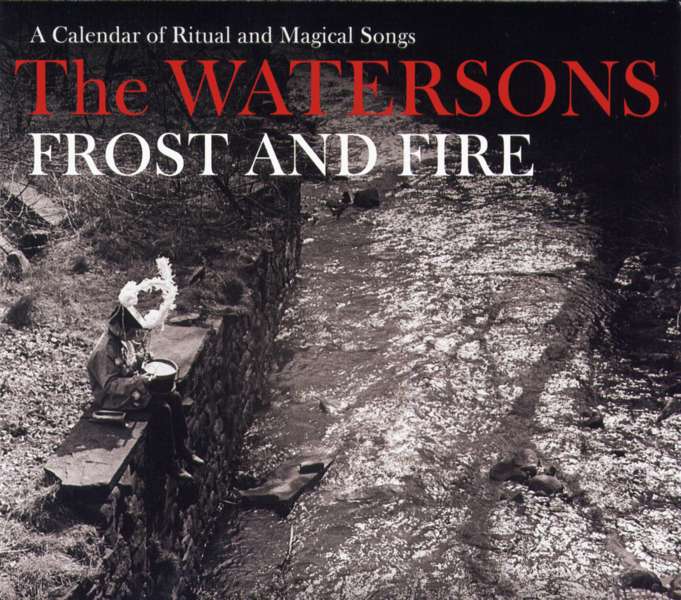
Perhaps the single most influential album on anglophillic US Paganism is Frost and Fire, by the Watersons. The Waterson family is one of several preserving families for this kind of English singing; Mom, Dad and the kids, at this point. Their kids and grandkids are still singing today.

Image result for frost and fire watersons
This album has a lot of folk-Christian references, if one considers the like of "Jesus Christ nailed to a big Yew tree" to be Christian. Many will recognize the May Carols, and Yule songs, and the many examples of the form and structure of folk versification has instructed many. It also offers a style of singing accessible to good singers who haven't a moment's schooling.

Anything by the Watersons will have some interesting stuff on it. The album "For Pence and Spicy Ale" doesn't seem to be up in entirety, but it has material I still use, as well as Music-Hall silliness such as 'Chickens in the Garden".

As an interlude, here's a Morris side singing a hunting song in the same vocal-group style. As is often the case, one must overlook the modern context of a fox-hunting song, and enjoy the lads singing about their dogs by their names.


The Clancy Brothers and Tommy Makem
The three brothers Clancy joined with their old friend Tommy Makem to create the sound that brought Irish folk music to the US in the folk-revival years of the 60s. Politically aware but willing to trade on  the old blarney, their singing introduced us to songs revolutionary, idyllic and occasionally drunken, though none of the lads were great drinkers, themselves.


The Irish repertoire in the US is heavily infected with vaudeville, and 'burlesque Irish' is a discernable category, in such gems as "Who Put the Overalls in Mrs Murphy's Chowder". Irish-Americans organized and fought to end the burlesque depiction of the lazy, drunken mick. Nevertheless if you, like me, are one who enjoys an ounce of the best (at a time, let us say) there are some lovely odes to the Water of Life, lots of cultural and nature references, and some good stories. Also this old material is very widely known, among folk-geeks and even those of more regular tastes.
Here's the boys on Pete Seeger's folk-music TV show, back at the dawn of TV time. Links will take you onward into the Clancy rep. The song straddles that Irish line, but it's still sung everywhere. Hang in for an Easter Egg with Pete.


Sea Shanties and Pye-rate songs
Yar, mates, tap the grog, willya? The Age of Sail, the establishment of world-wide deep-sea travels however perilous, and the creation of great national and commercial navies by the European powers led to a category of work and leisure song that is still recalled and sung. The list is uncounted, by me, at least, but here is one of my fave collections. And here's another, from the Smithsonian collections, and a third, with some more popular sing-its.


Shanties are primarily work-songs, the rhythm meant to time and coordinate work with pulleys, ropes and winches. They are ideal for raggedy, fun-time singing, and can spring up unexpectedly...


Silly Wizard

Lest we neglect the northern Gaels and Scots, let me commend the work of the seminal Scots folk band Silly Wizard. Led by the gifted Andy Stewart they adapted Scottish and Irish songs, added an instrumental element that sometimes featured Dougie MacLean on the fiddle, and introduced new songs that have sunk seamlessly into folk performance.
Fun with dialects is part of the joy of folk-music. This thick Scots brogue amounts to English, nearly...
For a more preservation playlist of Jacobite Scots ballads, go here.
Steeleye Span & Pentangle
In the early 70's Steeleye Span, a folk-rock supergroup consisting of Tim Hart, Maddie Prior, Ashley Hutchings, Martin Carthy and others created a modern sound that combined fine a capella vocals with hot electric fiddle and guitar to create a unique sound. Their first 4 or 5 albums, beginning with "Hark! The Village Wait" and "Please To See the King" including the classic "Below the Salt" and "Parcel of Rogues". This music informed the Neopagan and early festival scene, and many filks have seen these songs end up in Pagan circles.
I may not neglect Pentangle, the work of  John Renbourne and Burt Jansch, with their compatriots. Their jazz-influenced approach took a different path from Steeleye's guitar-rock style, but their influence extended to Bob Dylan, who hung with them on his UK travels.
This period of music deserves an article of its own, which I'm not proceeding to at this time. I'll leave you with a band composed of some of the children of these famous players, who are updating the music in their own way.
Sing, my friends, and be happy!

Friday, February 3, 2017

No One Way


I’ll make a deal with you, dear reader; I’ll only directly mention present political events when they have a direct bearing on the themes of el bloggo – Druid Magic and Pagan Occultism. Folks can see more of my political thoughts on Facebook, should they have that taste.

The single scariest thing I've heard our new president say (yet) is the assertion that American patriotic unity should derive from the belief in a Creator God, and that religion could unify the nation. In his inaugural address he painted a picture of unity based on “The same Creator God” across the continent. The president, never before a man of any noticeable spiritual inclination, seems willing to allow his office to become the platform for the theocratic visions of the worst elements of modern Christianity – Dominionists and Christian Reconstructionists. 

I object to this on both political and philosophical levels. Politically, giving churches and the modern interpreters of ancient scriptures political and social power has been a reliable formula for oppression. In the US we seek a society based on liberty, and limiting liberty according to the imagined ‘laws’ of one sect or another is not the path to growth and prosperity. Rather, I think that the goals of American liberty are served when every neighbor is free to worship the gods or God or whatever as they see fit. When we make unity around the common welfare, not around a common mythology; I value feeding my neighbor far more highly than I value worshipping with my neighbor. I would make it the government’s business (not the church’s, incidentally) to see that all our people are fed, and not it’s business to see that all our people worship together, or worship the same thing, or being, or whatever.


Philosophically I am highly suspicious that monotheism itself is a toxic idea. To take this to first principles, I think that because I think that monotheism is simply false. There is no one creator being, no being that rules the spiritual cosmos and decides the fate of souls. The gods and spirits live in the same Great Dance as we do, and existence proceeds from all of our actions. That is to say, I am a polytheist and animist on a mythic level – divinity is best expressed as multiple persons.

So, in order to make monotheism even vaguely rational one must compose a vast web of new rules, imposed boundaries and leaps of faith. Here, read this little jest, about the blind men and the beasts. As various locations and peoples try to express this One God, they inevitably create their own local version of it (that’s how religion actually works). Since monotheism usually comes with a strong “us-v-them” component, the differences between my One God and yours must be reconciled, often based on which faction holds political authority at the time.

Warfare based on religion was not unheard-of among polytheist peoples, but almost so. Polytheists expected their neighbors to have different but recognizable religions, and often left one another’s ways alone, even in victory. Gods of other peoples were not ‘false’, and nobody wanted a strange god’s ill-will. But the monotheists redefined all the spirits of the polytheistic world as ‘devils’, and almost immediately took up crusade against them. When competing monotheist ideas arose, those were treated as equally ‘Satanic’.

Perhaps I ramble. My assertion is that any attempt to unite a diverse group of people under one religion must amount to dire oppression. There is no Great Truth that will just make all the Jews and Bahais and Voodooists and witches and Baptists and Johannites and all to just say “Oh… yeah, that seems right”. The inevitable historic path to monotheistic unity has been the burning of temples and books.

So, if the government, or the society, comes to me and demands that I take up the new state cult… we’ll see. I’m a polytheist – as long as I can keep my gods, I always have room for another, I suppose. That hasn’t been how such things have usually gone.

Thursday, January 26, 2017

Magic for the Resistance

Practical Strategies for the Time and Season.


Many of my friends are concerned and dismayed by the political turn in the US this year. After some years of slow progress toward a more progressive country we seem to have taken a sharp turn. The current conservative movement would like to advance their agenda through the coming administration, an agenda which I perceive as involving a reduction in personal liberty, an increased dependency of people on their “employers” and decreased regulation and management of dangerous industrial systems. I expect all that to lead to reduced prosperity, declining health, increased oppression, and the empowerment of the police.


Of course my personal concern is the development and establishment of polytheistic religion and magic in modern culture. This makes me particularly concerned about the political connection between conservative monotheisms and the US government. I hope my readers will be with me when I skip a long historical bullet-list of reasons for the assertion that granting political authority to conservative monotheism has not, historically, led to liberty and prosperity. If right-wing Christianity gains in authority I would expect to see examples of the direct persecution and disempowerment of non-Christian institutions. Whether this would extend to the usual neopagan back-yard circles and public-park gatherings is a matter of anxiety, but not yet of record. Certainly it can’t be good news for those of us working to build lasting Pagan institutions.


Pagan and occult practitioners have a specialized body of occult skills that can be drawn upon to support us in these times. I hope that Pagan organizers and leaders will choose to boldly and publicly continue our religious work, regardless of the social climate, or the nattering of Dominionists or Christian reconstructionists. Our communities have made a good start at producing engines of blessing and growth for our society, and that work must continue. I hope, too, that we can hold to the founding principles of the USA – that no religion (or religious or spiritual principle-set) has a special place guiding our government. Our government is guided by the votes and voices of the public, and members of the public may be guided by religion or spirituality, whether Christian, Hindu, Neopagan, Humanist or whatever. Together they make the currents on which our ship of state must sail.


In context of that multiple web of influences I believe in pursuing one’s political goals actively. ‘Tis the season, my kin, to begin organizing locally. Join the Democrats if you can stand it, or get working on that new party. We need some real practical progressives running for congress in 2018.


But witches and magicians have that little extra angle. In our study of the occult forces and influences of nature and spirit, we have learned how to apply just that little bit of extra pressure, that perfect poke in that unseen pressure point, that could turn a head at the right moment or change the emotional condition of a community, or even Cripple the Whole Fucking Deathstar… er… ya know… That is, we can use magic consciously and directly. 


So let me ruminate a bit on how to apply the basics of sorcery on a social and political level. I am indebted to Jason Miller for helping to remind all practitioners of how to use traditional practical magic systematically, how to make the magical link effectively, and how to plan and execute a campaign of spellcraft.

I: Protection.

If we’re to engage an opponent it is best to be armored. I might suggest a three-layer approach.

1: Personal Talismanic Protection: If you’re an urban activist, or plan to be demonstrating and standing at the barricade, it is wise to have portable and personal magical protection, traditionally anchored in one or more amulets and talismans. There are many variation of how to prepare and consecrate such a talisman, including my own

My own experience has relied on a single personal protective talisman, an object that is never apart from my person for more than minutes at a time. It would certainly be possible to create multiple items with more specific intentions – a Saturn protection for physical harm, a Solar charm to increase one’s charisma and boldness, etc.

2: House and Boundary Wards: For those using their home or property for Pagan worship, or who have other reason to be concerned about visits from armed agents of the government, boundary customs are useful. This can be arranged in several layers as well.


One can begin with the edges of one’s property. The obvious entrances can serve as symbolic of any approach, and so drawing a line across the driveway or walkways with Stay-away Powder or red brick dust, or other materia. Here’s something:


Wall-water

Draw water from the primary water-source of your home or land (for most people that will be the faucet). Take 1/3 of it and put it to heat, (usually on your cooking stove) saying:

Let the Fire be kindled,
Let there be light in the darkness
Let the Fire come into the Water,
I set this spell to boil
Take a good pinch each of vervain, hawthorn and rue, and add them to the water as it comes to a boil, saying, for each:
Into this pot I place my will
That it may be boiled in the Water & the Fire
Let this be a warding; let this be a turning; let this be as a wall against all ill.
 Take a second third of the water and set it in a place where the light of the sun and waxing moon can shine on it, and leave it there for one full turning of day and night.
In the last third of the water, add a good pinch of crystalline salt, saying:

Let Earth and Water be joined

The powers of making, of gounding, of cleansing.

That which needs burning, let it be burned

That which needs turning, let it be turned
That which needs keeping, let it be well-kept. 

Bring all three parts brought together but not yet mixed, under a waxing moon, perhaps in the first quarter. Make all ready, and hallow the space and the work as you know how. Mingle the three parts together, as you conjure with something like this charm: 
Green leaf, salt, and moon and sun

Join these portions into one
Turn aside invaders all
Like a mighty castle wall


Stand you firm in spirit-curtain
Keep this (place) from evil, certain
Turn aside approaching ill
In the place where you are spilled.

Moonlight, sunlight, sky and land
Joined here by my will and hand

Turn aside opponents all
Water of my magic wall.

Jug the water tightly, and finish the work as is proper. Such a potion can be poured at entrances and walkways, as a first line of defense.


3: Sweetening the Police: If social authority is really going to show up at your door it will probably take one of two forms – either the uniformed police, or a band of self-authorized neighbors. The latter is difficult to enchant against in advance, unless you feel pretty sure about which of your neighbors is a jerk. If you have the latter problem, then all this can be applied to individual neighbors as well. Trying to sweeten the ‘mood’ of a community is a more difficult endeavor. (Here’s one very good account of such an experiment)

Police departments are composed of a limited number of specific individuals, and led by an even smaller number. Most of the leadership will have pictures posted on an internet ‘facebook’ (in the original sense), which allows for an easy basic object-link, perhaps along with the distinctive badge or logo of the local cadre. Consider stopping in to your local police headquarters to pick up a brochure. Pages of such stuff can be printed, folded up and either inserted in a Honey Jar (here’s a Druid-y version of the traditional hoodoo spell) vessel or placed beneath it as candles are burned on the lid. 


The text of my Honey Jar spell is arranged as a love spell of the usual sort, and assumes that you want a ‘result’ in the near future. That approach could be used before a demonstration or direct action, in hopes of improving the mood and behavior of the police that become involved, and their bosses. When using the same tech for a long-term effort such as being and staying welcome in a community, for instance, the whole spell can be continued at need.


II: Alliances
Organizing and resistance requires numbers. Especially if one doesn’t have money. We work to gather like-minded people together, to work our political will by the democratic traditions of petition, protest and direct action. There’s no reason to leave out the ghosts and daemons.

As in much spirit-work, I suggest beginning with the Ancestors and the Dead. The front end of this work can be built into public political rhetoric. Let the newly-activated hear the names and stories of Harriet Tubman, Frederick Douglas and Sojourner Truth, of John Brown. Let them know who Saul Alinsky was, and bring to mind the countless unknown leaders of the Labor movement. Protest and resistance stand as proud memories for our nation, and, as we say, that which is remembered lives. Even the tales of our colonial founders have a place in the narrative of people’s resistance.


Rhetoric can be empowered by direct spiritual work with those beings. My friends at the Niagra Voodoo Shrine have been working to good effect to establish Harriet “Mama Moses” Tubman as an ally, and plenty of experimental conjure could be done to find a cadre of spirits willing to act with one’s local organizing. If we must stand, let us stand with heroes at our back. If we must march, let spirits march with us.

And not just the Dead. If one is working on and with a specific piece of land then work with the Genius Locus of that place seems mandatory. This applies whether the land is one’s home, or a specific target patch in environmental or housing/development work. The web of symbols, laws and prayers that every government uses produce a de facto level of magical “claiming” in many such cases. It is valuable to stake one’s own claim and introduce oneself to ‘the Locals’ through simple rites such as those at this link. With such an introduction accomplished the magician can conjure specific ally spirits for defense and for support in direct action.

In my opinion the details of religion are best kept separate from the work of organizing. I don’t appreciate it when a Christian ally tries to open a prayer-session, and I don’t think we should try to get our fellow organizers to join us in offerings to the gods. That said, there are several deities in the well-known pantheons that seem proper for the work of resistance and restoration.

Shiva comes to mind first. He is the Lord of Yoga (yoga is best translated as ‘magic’). He is commonly called the god of ‘destruction’, because he will, when time is right, open his big Third Eye and burn away the manifest cosmos to make room for the next one. On the personal level he is thus understood as the lord of enlightenment, who burns away the veil of illusion to reveal spiritual truth. In turn that seems to make him the very patron of the work that needs doing now – the burning away of the rickety structure of late fossil-fuel civilization and post-Christian society, to make room for the New World.

Shiva’s counterpart in Euro myth is Dionysos, the mysterious son of Zeus who becomes the god of wine, sexual pleasure, social inversion and mystery-religion enlightenment. Dionysian practice was stifled in the West by the rise of Christianity, while Shiva’s cult and philosophy continued into modern times. We don’t have as much Lore about Dionysos, but he’s much more directly connected than Shiva to our usual cultural heritage.


As a bit of practical fun, both Shiva and Dionysos are depicted as the leaders of huge marches of ghosts, witches, daemons, etc. I love the idea of inviting them to attend a march, bringing their retinue. Look out folks, here comes not only a few thousand angry citizens, but a countless parade of spirits!


III: Persuasion
In working for specific goals it is often a specific public official that stands between the organizer and the outcome. The work of enchantment and persuasion-at a distance is central to a lot of practical magic, and it can be applied here as well. As always, this does not amount to cursing or hexing. Attempts to persuade one another are standard parts of human interaction – adding the occult component is as ethical as dressing well for an interview.

The single most important factor in such work is the establishment of the magical link between the magician and the target. While public servants are likely to have pictures easily available, such links are rather third-tier. Consider corresponding with the elected or law-enforcement official in an effort to get a specimen of their signature. (even a digital version is probably better than a public photo) Once you have such a link you can use sweetening spells if your mood is still good, or consider something a little more hot and rough if the urgency is greater.


Devising the message of such influence work is important. This provides an opportunity to narrow and clarify your targeting. Magical work intended to “save the Earth” amounts, usually, to nothing. Choose a legislator or officer, decide what you need them to do in order to gain a specific benefit, and express that in a simple, concise statement (preferably a single sentence or declaration). Incidentally that can be a valuable public prop as well – consider using it in press releases, protest-signs, etc – especially if you were to sigilize it.


Correspondence is also an opportunity to get your own spellwork into the hands, or at least the offices, of your target. Make a nice letterhead with your sigils embedded in the art. Send your spell-intentions along by treating the edges of the letter or envelope in some nice bend-over oil or the like. Consider stopping in to their offices to deliver a little of the same to the doorknobs and walkways. (I suggest avoiding white powders, these days ;) )


Allies can also be brought into play. Consider building a “whispering campaign” of spirits around the target to keep pressure on toward your goal. Have you made alliance with former Mayors of your town, Governors, etc? Is there a related category of the Dead (veterans, grandmothers, etc) that can be set to it? What spirits can be set to ‘haunt’ the situation?


Most of this advice is rather long-term, based on the drip-and-wear principle. Moments of urgency may require a more direct spell, or a specific conjuring of a spirit to do the work of persuasion. When that happens any preliminary work to establish the magical link can only be helpful.


Behind all of this detail, I think that we must face the coming years with our hearts turned toward those ancient spirits called Liberty, Wisdom, and Justice. I totally support the use of the Lady Liberty figure as a focus, and keep her torch and shining crown in my heart even as I seek a foxier cleverness to support more specific goals.

May the Gods and Spirits bless us, with Liberty and Justice for all.